Greater Manchester commuters set for faster journeys as major track repairs end
By Hannah Richardson 5th Nov 2026
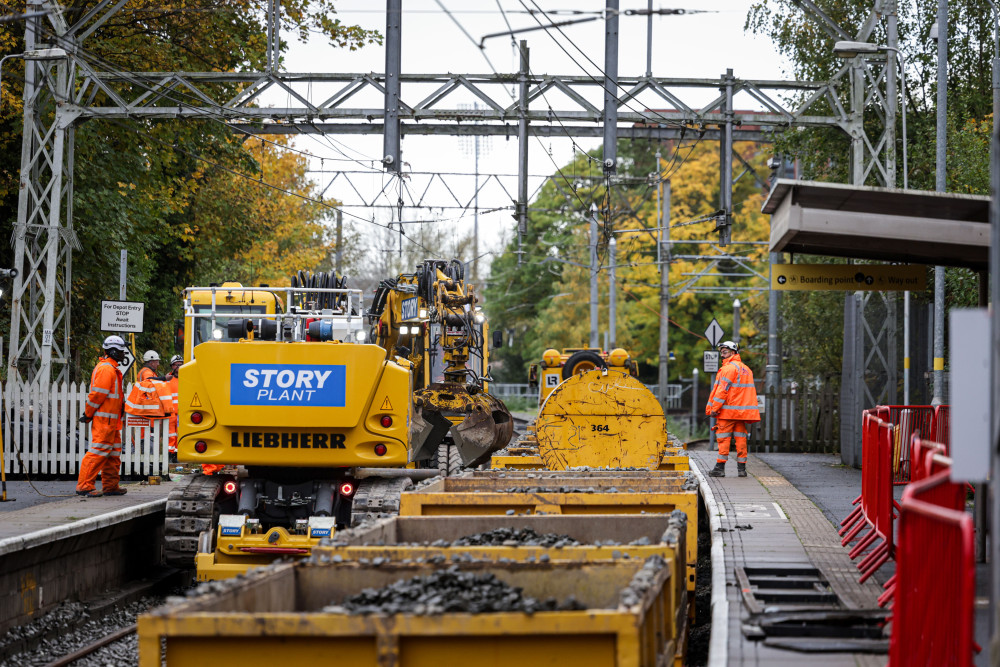
A complex series of works is being undertaken along a busy stretch of Greater Manchester's tram line.
Four kilometres of track has been dug up and replaced in a bid to future-proof the network for decades to come. The process is so involved that it is being done in three stages in an effort to keep the disruption in more manageable chunks.
Stage two is now coming to a close. Over the last two weeks, no trams have been running on the Altrincham, Trafford Centre and Eccles lines.
Commuters have reported 'dangerously overcrowded' buses and insufficient capacity while the lines are down. One traveller reported 40 minute waits for buses because of cancellations.
So what does the project actually involve and why does it need to happen? We headed out to Cornbrook station to take a look behind the scenes and talk to the people leading the project.
Cornbrook is one of the busiest routes in Europe, with trams passing through it every 30 seconds for 20 hours a day, seven days a week, when all lines are open. But the rails there have reached the end of their 30-year lifespan.
Transport for Greater Manchester (TfGM) has previously said the work 'has to happen' to 'make sure everyone is safe and secure' on the Network. But, beyond public safety, the works will also improve journeys for passengers, bosses have promised.
This is because speed restrictions along this stretch of the network can be lifted once the rails are replaced. TfGM said this latest round of work could see 60 seconds saved on journey times compared to timings prior to any work taking place.
The scheme is more complicated than simply lifting and replacing the rails, however. The existing track is removed and the land excavated to 'formation level'.
Then ballast – material to support the line – is laid, followed by sleepers, and the rails installed. These are clipped to the sleepers, before another round of ballast is added. This is then tamped down to level and align the tracks.
Network director Ian Davies said: "A lot of this track was reaching 30 years old. It was right at the edge of its life cycle. So we've come in now and we've replaced all of this track.
"Around 4000 m of track have been replaced over this piece of work. So we're really doing it to make sure our network is safe and ready for the future."
Weather conditions also have to be taken into account. Part of the work has seen around 620m of new drainage installed along the stretch to prevent water collecting along the line.
The metal rails also have to be 'stressed' – a process that induces heat into the metal. The aim, we were told, is to make the rail think it is always 27 degrees.
This then increases its resilience when outside temperatures soar or plummet. If the rail gets too cold, it can snap. Too hot and it could buckle.
The sheer weight of the materials being used also further complicates the job. The rails, split into 18m lengths to then be welded together, come in at around 900kg.
The sleepers can weigh between 250kg and 300kg depending on the type used. If placed manually, four or five people would be needed to move them.
However, TfGM has brought in specialist machinery for the work to help speed up the process. It now has equipment to lift the sections of track into place and level the ground beneath it.
Machinery is now also being used to clip the infrastructure together. The gear can install four clips for every one that could be done by hand.
Bosses estimate this more modern approach has saved them – and passengers – a couple of weeks.
Mr Davies added: "It's a significant piece of work and it would take a lot longer to do this if we didn't bring in the new technology. So we've got machinery that drops in several sleepers at a time and then we've brought in some new technology completely that actually puts the clips in along the track.
"It's a process where one follows the other, so the sleepers will be put down, the track will go on and then the clips will come in afterwards on that machinery. If we hadn't done that, it would have taken our workforce maybe two weeks longer than it's currently taken."
While the current works are drawing to a close, travellers will face a final round of disruption next year for phase three. This is expected to take place over the Easter period.
This will see the last stretch of the track around Cornbrook replaced.
Once that is done, Mr Davies said he hopes TfGM will not have to come back to this stretch for another 15 to 20 years.
He added: "We've taken all of the speed restrictions off the track where we've replaced it. That means the passengers actually get improved journey times. The trams move quicker, passengers are happy, and our drivers are happier as well."
Mr Davies continued: "We have listened to what you said to us last time and we've listened to what you said to us this time. So at the start of this week, we put in direct services between Eccles and Media City.
"We've put additional buses on commercial services, 30, 33, 50, 250, 263. So we have listened to you and we have made changes.
"I know it's disruptive. I'd like to apologise again for the disruption whilst we've completed this work."
Phase two work is expected to be completed this weekend, with the lines open from Monday, November 2.
CHECK OUT OUR Jobs Section HERE!
sale vacancies updated hourly!
Click here to see more: sale jobs
Share: